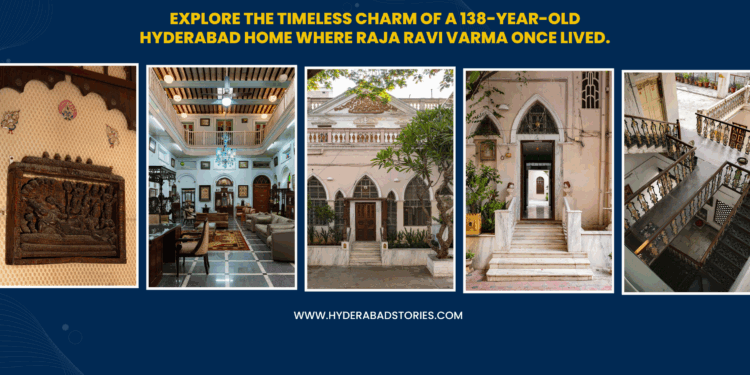
Bank Street in Koti owes its name to the 25 banks that once anchored its legacy. But hidden just beyond its noise and chaos, a quiet lane leads to a time capsule — the Raja Tarmakdas family kothi. Built in 1887, this heritage home is one of the last remnants of an era when Hyderabad’s elite lived in grand havelis, rich with artistry and tradition. It now quietly carries forward the legacy of the Nizams’ cultural splendor.

A carved wooden portico frames the main entrance, where Gothic arches meet classical proportions and Indian craftsmanship. The upper façade, adorned with graceful stucco detailing, whispers of a refined era gone by.

This 30,000-square-foot residence, thoughtfully constructed with 108 openings across two levels, reflects the traditional reverence for the number nine. Its history is equally textured — in the early 20th century, it hosted Raja Ravi Varma, who arrived on a royal commission to paint the Nizam’s portrait. In a surprising turn, the painting was never accepted, adding a layer of intrigue to an already storied home.
A Home Without a Count
Ask Arvind Kumar Tarmakdas, the 70-year-old patriarch, how many rooms his ancestral home holds, and he chuckles, “We’ve lost count.” His daughter, Jyothi Das, offers a vivid glimpse into the home’s evolving spirit. “Growing up, there were thirteen of us — and everyone carved out their own space. A room for Kathak, one for block printing, another for table tennis — and just like that, new rooms would appear. Some of us even had our own godowns!”
Also read: Inside Sonam Kapoor’s Mumbai home — a maximalist cocoon of Indian craftsmanship and heritage
A Stately Welcome
As you drive in, two towering Indian mast trees stand sentinel, framing the path with quiet grandeur. A flame-bright Gulmohar tree in full bloom splashes the home’s façade with bursts of orange, while a serene temple tree anchors the opposite end of the entrance. The house itself is a study in elegance — its architecture a graceful fusion of Gothic and Indo-European influences. Echoes of this style can still be seen in neighboring landmarks like the British Residency and the former Raja Pratab Girji ki kothi, now home to the Government ENT Hospital.


Architectural Grandeur, Layered with Legacy
The home’s symmetrical façade draws the eye to a central entrance, framed by a pitched wooden portico and flanked by tall, pointed arch windows that evoke the elegance of ecclesiastical architecture. Above, a classical pediment adorned with intricate stucco work brings a sense of quiet grandeur — a hallmark of elite Hyderabadi homes from the 19th and early 20th centuries.
Step inside, and a long, art-laden hallway ushers you into the heart of the home — the formal drawing room. This 26-foot-high, double-height space is encircled by a mezzanine gallery on all four sides, bordered by a meticulously carved wooden balustrade. Every corner of the room breathes history, not just through its design but its past life — this very hall once housed the Bank of India’s local office from 1949 until 1987, after which the family reclaimed it as a part of their private residence.


To the visitor, the salon-like room feels less like a living space and more like a portal into Aladdin’s cave — layered with history, texture, and opulence. Arched niches and deep-set doors accentuate the soaring height of the hall, while every surface seems to shimmer with stories. The room is a visual feast, where art and antiques converge in dramatic harmony.
“Every object in this house carries a story,” says Jyothi, gesturing around the space. “This one room alone holds Kalamkari and Tanjore paintings, a Burmese chandelier in a striking shade of blue, intricate kadhi and appliqué textiles, and furniture carved from Kashmir’s famed walnut wood. It’s from a time when maximalism wasn’t a style — it was a way of life.”

A Living Legacy
Just off the family living area lies the courtyard — the true heart of the home. It gently guides you toward a staircase that winds upward, connecting the living quarters with the private temple of their family deity, Lord Krishna. This sacred path leads to a series of nine dedicated rooms, each serving a ceremonial function: the kitchen, the doodh garh (milk room), the poshak garh (clothes room), the aarti room, and more — each space echoing devotion woven into daily life. The upper floor houses private suites, offering quiet retreat above the spiritual center below.
Over the past century, the home has evolved — not in spirit, but in form. Arvind and his son Anand have painstakingly modernized it, introducing new-age amenities while retaining its soul. From ancient closed wells to sleek wrought iron staircases replacing original stone, every change has been a respectful nod to progress without erasing the past. The home stands today as a blend of heritage and functionality, timeless yet lived-in.
For Jyothi, who grew up in this ever-evolving sanctuary, every corner holds a memory, every crack a story. The house breathes with moods and magic, shaped by generations. While maintaining such a vast residence is no small feat — Diwali preparations like whitewashing begin as early as July — it’s their deep reverence for legacy that keeps the spirit of the home alive.


The Stories of the Past
For the past five years, Jyothi has taken on the immense task of curating the family’s vast collection of heirlooms — a journey filled with unexpected discoveries and quiet revelations. Her unwavering spirit has led her deep into forgotten corners of the house, where history patiently waited to be found.
One particular room — stacked with nearly 200 cartons — turned out to be a treasure trove. Within it lay scattered pages of a rare manuscript of The Rubaiyat of Omar Khayyam, invitations from Hyderabad’s colonial era elites (including one to meet the Viceroy and Marchioness of Linlithgow), stamp paper dating back to 1943, and fragments of rare textiles: shimmering gold-embroidered cloth from China, delicate European lace, and more — each item tumbling out with a story to tell.
Jyothi, ever the resourceful steward, finds ways to give these relics new life. Torn silver borders are reborn as chains for Sreenathji. Teakwood beams, long-forgotten in a godown, are transformed into elegant furniture. “For us, anything under 50 years is still new,” she laughs. “Every day is a discovery. And luckily, this house has so many corners begging to be adorned — it keeps us happily occupied.”


Of Fables and Footprints
Rooted in the Pushtimarga Sampradaya, the family has nurtured a deep spiritual and aesthetic tradition — one that extends far beyond prayer and ritual. Over generations, they have been passionate collectors of art, curating a legacy steeped in devotion and creativity. Their eye for detail and reverence for heritage has resulted in a collection of rare Kalamkaris and Pichwais, some of which have found their way into museum collections across the world — silent emissaries of a timeless cultural lineage.
A Living Museum
What remains within this antiquarian home is nothing short of breathtaking. The hallways come alive with exquisite Kalamkari paintings rendered in natural dyes of madder and indigo — hues rarely seen today — illustrating vivid scenes from Indian mythology. Along the walls, Tanjore artworks shimmer with rich gold leaf and bold pigments, casting a spell of timeless grandeur over all who behold them.
Anchoring the collection are monumental Pichwais, some measuring 10 by 10 feet, each one centuries old and steeped in devotion. Their themes, drawn from temple traditions and Vaishnavite lore, continue to echo the family’s deep spiritual and artistic lineage. Together, these pieces transform the home into a sanctuary of heritage — a living museum where every corner tells a story.


Threads of Memory
Beyond its remarkable art, the home is gently strewn with a lifetime of collectibles — vintage mashru weaves, kutchi textile art, and handcrafted wooden curios gathered over decades. Each item is a quiet witness to a family’s journey through time.
Among the most treasured heirlooms is Arvind’s wedding sherwani, woven from near-extinct Himroo fabric and adorned with delicate silver filigree buttons. Today, it rests in Hyderabad’s Salar Jung Museum — a testament to the rare craftsmanship it embodies. Yet for Arvind, the house itself holds far more meaning. As the last family member to be born within its walls, he feels an unshakable bond with its spirit. “This is where my great-grandmother spent her final moments,” he recalls, “her lips whispering Srikrishna Sharanam Mama — a memory that lingers in the very air.”
Spanning generations and bridging eras, this home is not just an address — it is a living chronicle. A space that has evolved with its people, it continues to hold together the threads of change, devotion, and everyday grace with effortless dignity.