Why the Financial District, Gachibowli, and the ORR have turned Rangareddy into the economic powerhouse of Telangana.
If you grew up in the 90s, “Hyderabad” meant Charminar, the bustling markets of Koti, and the administrative pulse of Secretariat. But if you look at the Telangana Socio-Economic Outlook 2026, the map of wealth has shifted.
Today, while Hyderabad remains the cultural soul of the state, its neighbor—Rangareddy—has officially snatched the crown as the economic powerhouse of India.
The Census Paradox
The numbers tell a story that feels almost impossible. According to the 2011 Census:
- Hyderabad’s Population: 39.43 Lakh
- Rangareddy’s Population: 24.26 Lakh
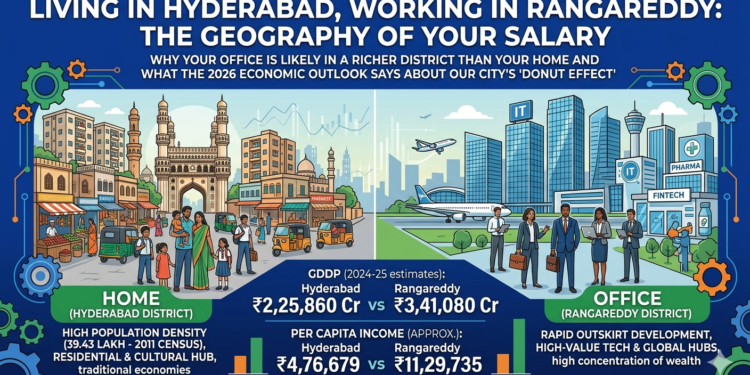
With nearly 1.5 million more people, you would expect Hyderabad to lead in total economic output (GDDP). Yet, the reality is the opposite. Rangareddy’s GDDP stands at a staggering ₹3,41,080 crore, while Hyderabad follows at ₹2,25,860 crore.
Why the “Outskirts” Won the Race
So, how did a district with fewer people become nearly twice as rich? The answer lies in the “Ring Road Revolution.”
- The Cyberabad Spillover: When we say “Hyderabad IT,” we are almost always talking about Rangareddy. Locations like Gachibowli, Kokapet, and the Financial District technically sit outside Hyderabad’s district borders.
- The High-Value Density: Hyderabad is a dense residential and traditional trading hub. Rangareddy, however, is home to the “big hitters”—the Google and Amazon campuses, the massive pharmaceutical clusters of Genome Valley, and the global gateway that is the Shamshabad Airport.
- The Commuter Effect: Every morning, lakhs of people leave their homes in the Hyderabad district to go to work in Rangareddy. They produce wealth in one district but sleep in the other.
The Per Capita Gap: A Million-Rupee Difference
This geographic shift creates a massive gap in individual wealth. The average resident in Rangareddy now accounts for a Per Capita Income of roughly ₹11,29,735, while Hyderabad’s stands at ₹4,76,679.
While both figures are well above the national average, it highlights a “Donut Effect”—where the center of the city remains the heritage core, but the “ring” around it is where the future is being built.
Looking Ahead
As Hyderabad continues to expand toward the Outer Ring Road, the lines between these districts are blurring for the average citizen. Whether you live in Banjara Hills (Hyderabad) or work in Financial District (Rangareddy), one thing is clear: the Hyderabad Metropolitan Region is becoming an unstoppable economic engine.