From two simple bins to a city-wide movement: How two homemakers transformed everyday habits across 23 communities—one cloth bag at a time.
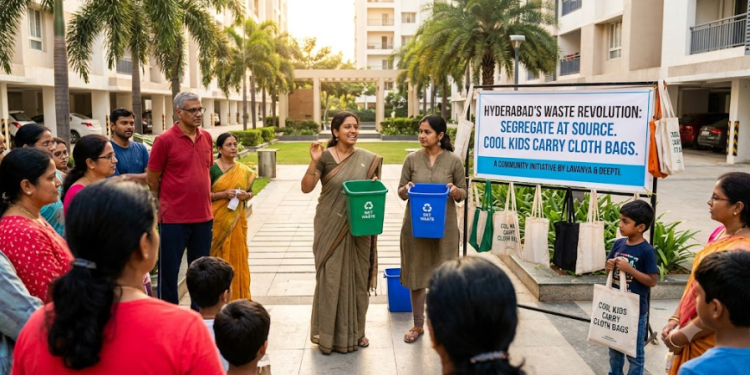
Every weekend across Hyderabad’s residential neighborhoods, you might catch a sight that feels deceptively simple: two women standing before a crowd, holding up two different colored bins.
No flashy presentations. No corporate sponsorships. Just two homemakers, a wet waste bin, a dry waste bin, and a straightforward message: Waste management begins at home.
For nearly four years, Lavanya Ganti and Deepti Reddy Kundur have spent their weekends convincing Hyderabad residents that source segregation isn’t just a civic duty—it’s the single most important step toward solving the city’s mounting garbage crisis.
“Where Does Our Garbage Really Go?”
Neither Lavanya, a software professional, nor Deepti, a pharmacist, ever planned to start an environmental movement. The pair first met while volunteering at a local government school. Having both lived abroad, they were haunted by a persistent question: Why do we admire pristine, trash-free cities overseas, but ignore where our own waste ends up back home?
Determined to find an answer, they started with their own households in Tellapur. They audited their daily trash, separated every item, and began speaking to anyone who would listen.
Their early advocacy was met with equal parts curiosity and amusement. Neighbors cheekily nicknamed them “the garbage people” for fussing over plastic wrappings, compostable scraps, and conscious consumption.
They didn’t mind the title. They kept going.
From One House to 2,000 Households
Instead of waiting for top-down municipal mandates, Lavanya and Deepti built their movement from the ground up. They started small—talking to friends, mothers, and kids in gated communities—before taking their proposal directly to Resident Welfare Associations (RWAs).
Their grassroots approach worked. What began in a single Tellapur home soon expanded to over 2,000 households across 26 gated communities, with 23 of those communities fully adopting mandatory waste segregation.
To turn separated waste into measurable impact, the duo partnered with Bintex, a data-driven recycling platform. Over the past two years alone, their collective efforts have diverted more than 152,000 kilograms (1.52 lakh kg) of dry waste away from Hyderabad’s overflowing landfills.
The Math Behind the Movement
Over two and a half years, the ripple effect of their simple two-bin system has yielded remarkable environmental returns:
- 300,000+ kg (3 lakh kg) of $\text{CO}_2$ emissions averted
- 1,353 trees saved from deforestation
- 180,000 liters (1.8 lakh liters) of fuel conserved
- 9 truckloads of waste cleared from a local lake by their 230-member volunteer network
Today, their work has expanded into textile and sanitary waste recycling, alongside educating local housing societies on how to comply with the New Solid Waste Management Rules.
“Cool Kids Carry Cloth Bags”
Perhaps the most profound change isn’t recorded in metric tons or landfill data, but in neighborhood culture.
The same neighbors who once teased “the garbage people” now separate their daily waste, refuse single-use plastic bottles, and keep reusable totes by their front doors. Children across these communities have embraced their catchy anthem: “Cool kids carry cloth bags.”
For two women who never set out to build a personal brand or chase social media clout, success looks like a kid choosing a canvas tote over a plastic bag. It’s proof that meaningful urban transformation doesn’t always begin in government offices.