The championship will see a fierce national turnout as wrestlers fight to secure titles in their respective weight divisions
The championship will see elite wrestlers from across the nation competing for titles across various categories. A cherished local tradition, the event has been held annually for over three decades, seeing only a brief hiatus during the COVID-19 pandemic. Organized by the Barkas Bamas Akhada Professional Wrestling Hub, the tournament honors a legacy started by founder Awad Bamas and furthered by Ustad Abdullah Bamas, who dedicated his life to training the youth in this traditional art.
The Event and its Prestige The championship is set to be a landmark event, featuring international referees and acclaimed wrestlers who will oversee the high-stakes matches. While drawing a national audience, the tournament also serves as a “Silver Jubilee Celebration,” with approximately 100 wrestlers from across Telangana expected to compete for titles in various weight categories. The event’s significance is further underscored by the presence of office bearers from the World Professional Wrestling Hub.
A Three-Decade Tradition Organized by the Bamas Akhada Professional Wrestling Hub, this tournament has been a staple of the sporting calendar for thirty years, pausing only briefly during the COVID-19 pandemic. The hub carries forward a powerful lineage, established by Awad Bamas and popularized by Ustad Abdullah Bamas, who spent decades mentoring local youth in the disciplined art of wrestling.
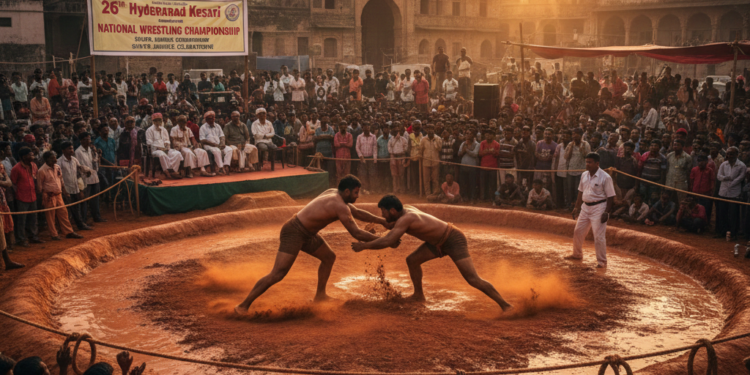
The Culture of the Akhada The older quarters of Hyderabad remain a sanctuary for traditional akhadas (mud-pits). These grounds were established by legendary pehelwans who earned prestigious titles such as Telangana Kesari and Hyderabad Kesari.
Today, the tradition lives on through rigorous daily rituals:
- The Grind: Young athletes undergo zor (practice) every day, mastering complex daavs (techniques) under the watchful eyes of their coaches.
- Traditional Conditioning: Training remains rooted in customary methods, including dand (traditional dips), baithak (squats performed with a hasil or iron ring), and rassa (rope climbing).
- The Soil: In a show of discipline and respect for the sport, the athletes themselves use spades to level the red mud ground daily, preparing the pit for friendly kushti matches.
This is a fascinating look at the rich wrestling culture of Hyderabad. I’ve integrated your new details into a polished, comprehensive narrative. I’ve organized it to flow from the prestige of the current event to the deeply rooted traditions of the Barkas community.
Refined Narrative: The Legacy of Hyderabad Wrestling
The Event and its Prestige
The championship is set to be a landmark event, featuring international referees and acclaimed wrestlers who will oversee the high-stakes matches. While drawing a national audience, the tournament also serves as a “Silver Jubilee Celebration,” with approximately 100 wrestlers from across Telangana expected to compete for titles in various weight categories. The event’s significance is further underscored by the presence of office bearers from the World Professional Wrestling Hub.
A Three-Decade Tradition
Organized by the Bamas Akhada Professional Wrestling Hub, this tournament has been a staple of the sporting calendar for thirty years, pausing only briefly during the COVID-19 pandemic. The hub carries forward a powerful lineage, established by Awad Bamas and popularized by Ustad Abdullah Bamas, who spent decades mentoring local youth in the disciplined art of wrestling.
The Culture of the Akhada
The older quarters of Hyderabad remain a sanctuary for traditional akhadas (mud-pits). These grounds were established by legendary pehelwans who earned prestigious titles such as Telangana Kesari and Hyderabad Kesari.
Today, the tradition lives on through rigorous daily rituals:
- The Grind: Young athletes undergo zor (practice) every day, mastering complex daavs (techniques) under the watchful eyes of their coaches.
- Traditional Conditioning: Training remains rooted in customary methods, including dand (traditional dips), baithak (squats performed with a hasil or iron ring), and rassa (rope climbing).
- The Soil: In a show of discipline and respect for the sport, the athletes themselves use spades to level the red mud ground daily, preparing the pit for friendly kushti matches.
Key Terminology Used
| Term | Meaning |
| Akhada | Traditional wrestling pit/gymnasium |
| Zor | Daily practice/physical training |
| Daav | Technical wrestling moves or maneuvers |
| Kushti | Traditional mud-pit wrestling |
| Dand & Baithak | Traditional Indian strength-building exercises |