
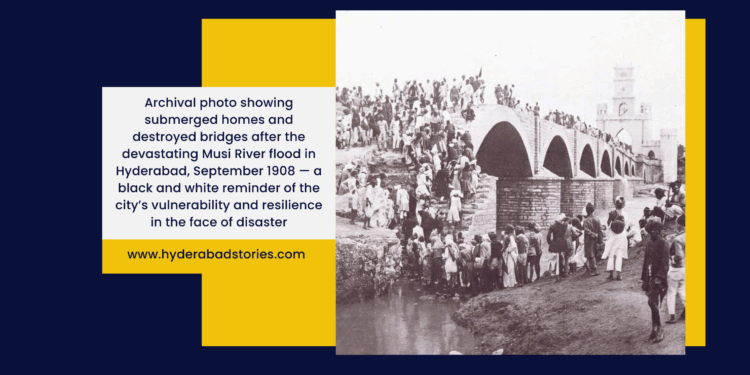
The terrifying memory of the Great Musi Flood of 1908 still lingers in Hyderabad’s collective consciousness, and yesterday’s flooding is a chilling reminder of the city’s vulnerability to nature’s fury. Every September, Hyderabad has witnessed its share of tragedy, but the events of 1908 and the recent deluge make this month particularly somber for the city.




The Ferocity of the 1908 Musi Flood
On 28 September 1908, relentless rain unleashed devastation across Hyderabad as the Musi River swelled and breached its banks. The tragedy, referred to locally as Thughyani Sitambar, killed an estimated 15,000–50,000 people, washed away vital bridges, and rendered the city nearly unrecognizable. More than 59,000 houses were damaged, and entire localities ceased to exist—images from the time show a city drowned and battered beyond measure. The catastrophic event led to sweeping reforms: the construction of the Osman Sagar and Himayat Sagar reservoirs, intended to buffer Hyderabad from future floods, and the modernization of essential infrastructure like Osmania Hospital and High Court.
September 2025: Musi’s Wrath Returns
Yesterday, after heavy rains lashed Hyderabad, the Musi River again broke its banks—a haunting echo of 1908. Inundation forced over 1,000 residents from low-lying areas into relief camps; major bridges such as Chaderghat and Moosarambagh were submerged under up to 10 feet of floodwater, severing connectivity and impacting thousands of lives. The Mahatma Gandhi Bus Station, the city’s busiest transport hub, was left waterlogged, and urgent rescue efforts were deployed to save stranded citizens. Key IT corridors in Madhapur and Gachibowli experienced massive gridlocks due to severe waterlogging, demonstrating how even the most modern sections of Hyderabad are not immune.
A City’s Reckoning With Its Past
Hyderabad’s administration responded quickly: opening the gates of Osman Sagar and Himayat Sagar reservoirs released a surge of water to protect the dams, but worsened urban flooding downstream. The government mobilized evacuation, relief, and rescue operations as roads, homes, and infrastructure were submerged across Rajendranagar, Chaderghat, Amberpet, and beyond. The recurrence of such catastrophic flooding begs the question—have lessons from 1908 been forgotten? Urban expansion, encroached floodplains, and compromised water bodies have left Hyderabad perilously exposed once more.
September: A Month of Tragedies—and Reflection
For Hyderabad, September is more than a page on the calendar; it is a season for remembrance and reflection. It is when the city mourns the lives lost, the communities uprooted, and the resilience tested over generations. The Musi River, once revered as a lifeline, has become a powerful reminder that nature, if neglected or mismanaged, reclaims what is hers.
As the city helps its displaced residents and confronts yet another watery disaster, the spirit of Hyderabad is tested again. The only path forward is to remember the tragedies of the past, strengthen planning for the future, and never let the lessons of 1908 or 2025 be washed away with the floodwaters.