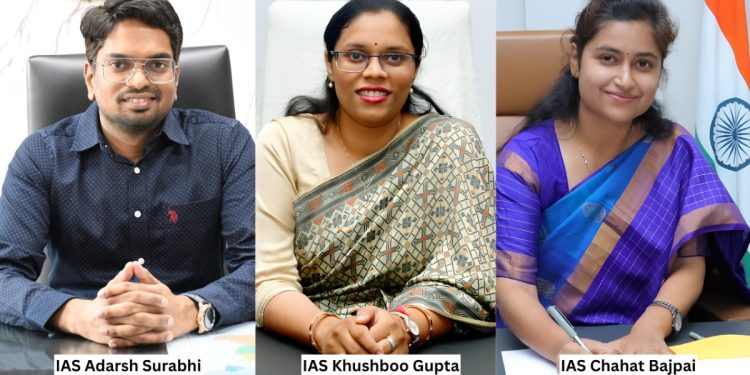
How a trio of 1994-born IAS officers—Adarsh Surabhi, Chahat Bajpai, and Khushboo Gupta—are bringing technical rigor, data-driven governance, and fresh perspective to public service across the state.
In the fast-paced landscape of Indian public administration, executive leadership is experiencing a noticeable demographic shift. Across Telangana, a new cohort of young civil servants is taking charge of district administration—bringing modern frameworks, data-driven methodologies, and an agile approach to local governance.
At the center of this administrative transition are three standout officers: Adarsh Surabhi, IAS, Chahat Bajpai, IAS, and Khushboo Gupta, IAS. All born in 1994, this trio currently holds the distinction of being the youngest District Collectors serving in the state.
While their age often makes headlines, their actual impact lies in how they navigate complex socio-economic realities, leverage technology, and execute large-scale welfare initiatives on the ground.
“Youth in administration isn’t just about age—it represents a generational shift toward digital-first problem solving, data tracking, and empathetic public engagement.”
1. Adarsh Surabhi, IAS — District Magistrate, Wanaparthy
Batch: 2018 | Key Focus: Public Health Innovation & Preventative Healthcare
An officer from the 2018 batch, Adarsh Surabhi has made preventative healthcare a cornerstone of his administration in Wanaparthy.
Surabhi pioneered “Mission Madhumeha,” an ambitious, district-wide initiative designed to screen all citizens over the age of 30 for non-communicable diseases, particularly diabetes. Driven by a personal family experience with the condition, Surabhi mobilized frontline ASHA workers for door-to-door screenings across rural and urban Wanaparthy.
To ensure long-term impact rather than a one-time drive, Surabhi’s team deployed customized digital tracking software and piloted Digital Health Cards across municipal wards. This platform tracks blood sugar levels from initial screening to hospital confirmation and medication delivery, creating a scalable model for rural public health monitoring.
2. Chahat Bajpai, IAS — District Magistrate, Hanamkonda
Batch: 2019 | Key Focus: Multi-Agency Integration & Urban Governance
Managing Hanamkonda—the urban, cultural, and educational heart of the greater Warangal region—requires balancing fast-paced urban expansion with heritage preservation.
Since taking charge as Collector, Chahat Bajpai (2019 batch) has distinguished herself through high-capacity multi-tasking and administrative integration. In addition to her role as District Magistrate, Bajpai has overseen critical concurrent charges, including acting Commissioner for the Greater Warangal Municipal Corporation (GWMC) and Vice-Chairperson of the Kakatiya Urban Development Authority (KUDA).
By bridging the gap between urban municipal bodies, development authorities, and revenue administration, Bajpai has accelerated civic infrastructure upgrades, streamlined urban grievance redressal, and strengthened inter-departmental coordination across the tri-city urban zone.
3. Khushboo Gupta, IAS — District Magistrate, Mahabubnagar
Batch: 2019 | Key Focus: Tech-Driven Welfare & Grassroots Execution
An IIT Delhi Computer Engineering graduate who secured All India Rank 80 in the 2019 Civil Services Examination, Khushboo Gupta brings technical precision to district administration.
Leading Mahabubnagar—a geographically vast district with both urban hubs and extensive agrarian pockets—Gupta focuses on optimizing service delivery through engineering-minded oversight. Her tenure centers on improving education quality in government schools, strengthening rural healthcare infrastructure, and ensuring transparency in municipal governance.
By embedding analytical monitoring into daily welfare operations, Gupta has worked to streamline government welfare distribution, ensuring benefits reach vulnerable beneficiaries at the true grassroots level.
A Shared Blueprint for Modern Governance
What links these three officers beyond their shared year of birth (1994) is a uniform approach to executive leadership:
- Digital-First Operations: From dedicated tracking applications in public health to structured grievance portals, they leverage software tools to audit progress rather than relying solely on paper files.
- Field Accessibility: Regular village visits, early-morning inspections, and open public interaction remain central to their administrative style.
- Cross-Sectoral Rigor: Whether managing heritage urban centers or agrarian districts, their focus remains on measurable metrics and sustainable execution.
As Telangana continues its rapid economic and social development, the leadership shown by Surabhi, Bajpai, and Gupta serves as an inspiring blueprint for what the modern Indian Administrative Service can achieve when youthful vision meets structured governance.