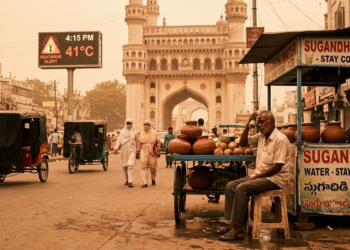
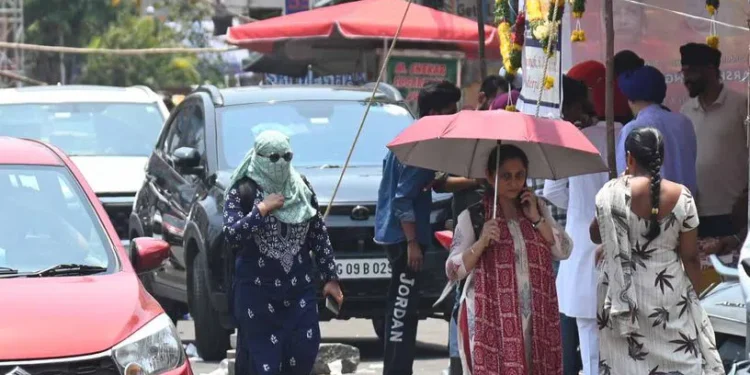
Uncovering the ‘Vertical Heat Paradox’ and the true cost of Hyderabad’s concrete jungle.
It’s April 2026, and if you’ve stepped out near Cyber Towers at 2:00 PM lately, you know the official IMD reading of 40.9°C feels like a polite understatement. While the weather bulletins give us the “air temperature,” the “ground reality” in the IT corridor is a different beast entirely.
Welcome to the Glass Cauldron—a phenomenon turning Hyderabad’s modern pride into a literal furnace.
The Vertical Heat Paradox
In the rush to build a “world-class” skyline, we’ve wrapped Hitec City and Gachibowli in reflective glass. In cooler climates, this helps trap heat. In the scorching heart of the Deccan Plateau, it does the opposite—it amplifies it.
The glass facades act as massive vertical mirrors, deflecting solar radiation directly down onto the asphalt. This is the Vertical Heat Paradox: the more we try to cool the inside of our buildings with AC, the more we bake the people on the outside.
Why Hitec City “Feels” Like 48°C
For the thousands of delivery partners, street vendors, and commuters, the “Real Feel” temperature isn’t just a number on an app.
- Double Exposure: You are hit by the sun from above and the reflected heat from the buildings on your left and right.
- Asphalt Heat Sinks: The black roads absorb this concentrated energy, reaching surface temperatures that can easily cross 55°C.
- The Humidity Trap: Even with clear skies, the localized heat from AC exhausts creates a micro-climate of stagnant, hot air.
The Jubilee Hills Oasis: A Natural Contrast
Just five kilometers away, parts of Jubilee Hills and Banjara Hills tell a different story. Why? Deep Canopy Cover. While Hitec City replaced soil with concrete, the older residential pockets of Hyderabad retained their old-growth trees.
The 5-Degree Difference: Surface temperature studies in April 2026 show that colonies with heavy tree cover maintain ground temperatures up to 5°C lower than the glass corridors of Madhapur.
Can We Cool the Cauldron?
As the IMD issues Orange Alerts for the week, it’s clear that Hyderabad needs a policy shift. From mandatory cool-roofing to a limit on glass-to-wall ratios in new constructions, the city must adapt or continue to swelter.
The “clear sky cycle” of the Deccan Plateau isn’t going away, but our architectural choices can change. Until then, if you’re heading to Hitec City, carry an extra bottle of water—you aren’t just walking through a city; you’re walking through a mirror.
What do you think? Should Hyderabad place a “Heat Tax” on buildings with 100% glass facades? Let us know in the comments below!