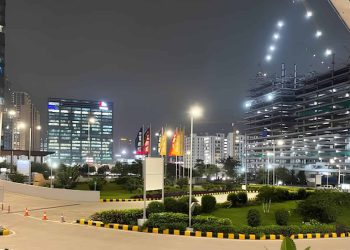
The proposed decision could regularise thousands of properties in Hafeezpet, Kondapur and Hitech City areas while generating an estimated Rs 1,000 crore in registration revenue
Hyderabad: The Telangana government is preparing to permit conditional registrations on long-disputed Paigah lands, potentially bringing relief to thousands of property owners in Hyderabad’s rapidly developed western corridor.
The move could regularise existing apartments, gated communities, commercial buildings and residential colonies in areas such as Hafeezpet, Kondapur and locations near Hitech City. It is also expected to generate nearly Rs 1,000 crore in registration revenue for the state government.
The properties are covered under Civil Suit No. 14 of 1958 and Civil Suit No. 7 of 1958, where ownership disputes between the government and private parties remain pending.
Nearly 600 acres already developed
Paigah lands spread across approximately 1,500 acres in Ranga Reddy and Medchal-Malkajgiri districts have remained under litigation for more than six decades.
Officials estimate that buildings have already been constructed on nearly 600 acres, particularly in Serilingampally mandal. Much of this development took place despite unresolved ownership claims and restrictions on property registrations.
Hafeezpet is among the most prominent affected areas. Disputed Paigah lands in Survey Nos. 77 to 80 have undergone extensive urbanisation over the years.
Of the 484 acres in Survey No. 80, approximately 430 acres are reportedly occupied by apartment complexes, gated communities, residential colonies and commercial developments. Only around 50 acres remain vacant.
According to officials cited by The Times of India, the government lost several legal cases concerning these lands, including cases before the Supreme Court. Registrations were subsequently permitted in some instances based on court orders. The Greater Hyderabad Municipal Corporation also granted permissions for high-rise buildings following judicial directions.
At present, registration of Paigah properties is generally prohibited unless specifically permitted by a court.
Lands may be removed from prohibited list
Revenue Minister Ponguleti Srinivas Reddy announced that lands covered under CS-14 and CS-7 would be removed from the prohibited properties list under Section 22A.
The government plans to introduce conditional registrations, under which sale and registration documents will clearly mention that ownership rights are subject to the final decisions of the Supreme Court and Telangana High Court.
Revenue Department Principal Secretary D.S. Lokesh Kumar said instructions relating to CS-14 and CS-7 lands would be issued on a case-by-case basis after examining the relevant court judgments.
The government is also reportedly considering permitting registrations on certain lands belonging to Gurukul Trust and Ayyappa Society.
Dispute dates back to 1958
The Paigah land dispute began in 1958. CS-14 is particularly significant as it concerns the partition of the Matruka properties belonging to Nawab Khursheed Jah Paigah.
Over the years, courts issued final decrees concerning several properties, with many decisions later upheld by the Supreme Court. However, the Telangana government continues to claim ownership over portions of the disputed land.
In May 2009, the government issued a memo based on recommendations made by an expert committee. The memo reportedly directed the mutation of CS-14 lands in favour of decree holders and their registered assignees.
The properties were subsequently included in the prohibited list under Section 22A of the Registration Act, preventing further registrations. Despite the restriction, officials said unauthorised construction and property development continued across several affected areas.
Disputes continue in Hydernagar and Shamshabad
Similar land disputes remain unresolved in Hydernagar, Ghansimiyaguda, Hasmathpet and other parts of Telangana.
Survey No. 172 in Hydernagar village near Kukatpally covers approximately 192 acres. In June 2023, the Supreme Court directed private parties to establish their ownership claims again, except for 54 acres covered under Original Side Appeal No. 55 of 2004.
Since the land covered under OSA No. 55 is exempt from the Supreme Court ruling relating to Survey No. 172, the state government is reportedly considering using the remaining land for a 2BHK housing project for economically weaker families.
In Ghansimiyaguda near Shamshabad, land in Survey Nos. 3 and 4 continues to face alleged encroachments. Certain properties covered under CS-7 are also located in Hasmathpet and surrounding areas.
If implemented, the conditional registration policy could provide property owners with an opportunity to complete transactions while ensuring that ownership claims remain subject to the final outcome of ongoing legal proceedings.